
Not every functional food application needs a concentrated extract. Sometimes what a formulation needs is the fruit itself — whole, recognizable, and simple enough to list as a single ingredient on the label.
In the functional food space, "clean label" has moved from marketing buzzword to formulation requirement. Consumers read ingredient lists. They respond to short ones. And for brands building products around naturally sourced, plant-based inputs, the ingredient itself has become part of the value proposition — not just what it does, but what it is and where it comes from.
That's the space where a whole-fruit ingredient like freeze-dried Maqui Berry powder fits: not as a high-potency extract, but as the berry itself — preserved, milled, and ready to formulate with. One ingredient, one line on the label, one origin story.
Clean Label Is More Than a Claim — It's What's Actually on the Ingredient List
"Clean label" has become one of the most used terms in the food industry. But for formulators, the concept comes down to something concrete: what does the ingredient list look like? Consumers increasingly read labels, and they respond to ingredient lists they can understand — short, recognizable, and free of chemical-sounding additives.
For berry-based functional foods, that creates a specific challenge. Many fruit-derived ingredients are concentrates, extracts, or blends that require carriers, maltodextrin, or other excipients to stabilize or standardize the powder. The result works well for potency, but the label reads differently from what "clean" implies.
A freeze-dried whole-fruit powder takes a different approach. When the process starts and ends with the fruit — no solvents, no carriers, no added compounds — the ingredient list is exactly one line: Maqui Berry.
What Freeze-Drying Preserves (and Why It Matters)
Freeze-drying works by sublimation: the frozen fruit is placed under vacuum, and the ice transitions directly to vapor without passing through a liquid phase. Because no high heat is applied, the fruit's cell structure remains largely intact — and with it, its natural composition.
For Maqui Berry (Aristotelia chilensis), this means the deep violet anthocyanins, dietary fiber, naturally occurring minerals like potassium, calcium, and iron, and vitamins C and E are preserved closer to their fresh-fruit levels than with conventional drying methods.
There's one more detail that matters for product differentiation: MNL Group's Freeze-Dried Maqui Berry Powder uses the whole fruit, including the seed. That's not incidental — the seed contributes to the powder's fiber content and to the berry's complete nutritional matrix. The result is a powder that represents the full Maqui Berry, not a fraction of it.
Freeze-Dried Maqui Berry Powder is the whole berry in powder form — natural fiber, micronutrients, and pigments preserved together. For applications that need a defined, standardized anthocyanin level and full water solubility — like functional beverages and antioxidant shots — Maqui XT® is the concentrated alternative. Both start from the same wild-harvested Patagonian Maqui Berry. Read more about Maqui XT® in functional beverages →
Where Whole-Fruit Maqui Powder Fits in Functional Food Formulation
The format defines the application. A freeze-dried whole-fruit powder behaves differently from a water-soluble concentrate — it's partially soluble, with a coarser, more textured profile that works best blended into full-bodied foods rather than clear liquids.
Smoothie Blends and Powdered Mixes
This is the most natural fit. Maqui powder adds its deep violet color, a slightly tart berry flavor, and a whole-fruit nutritional profile to smoothie mixes, functional powders, and single-serve sachets. For brands in the "superfruit blend" space, listing Maqui Berry as a standalone ingredient — not an extract or concentrate — adds formulation credibility and label simplicity.
Bars, Snacks, and Bakery
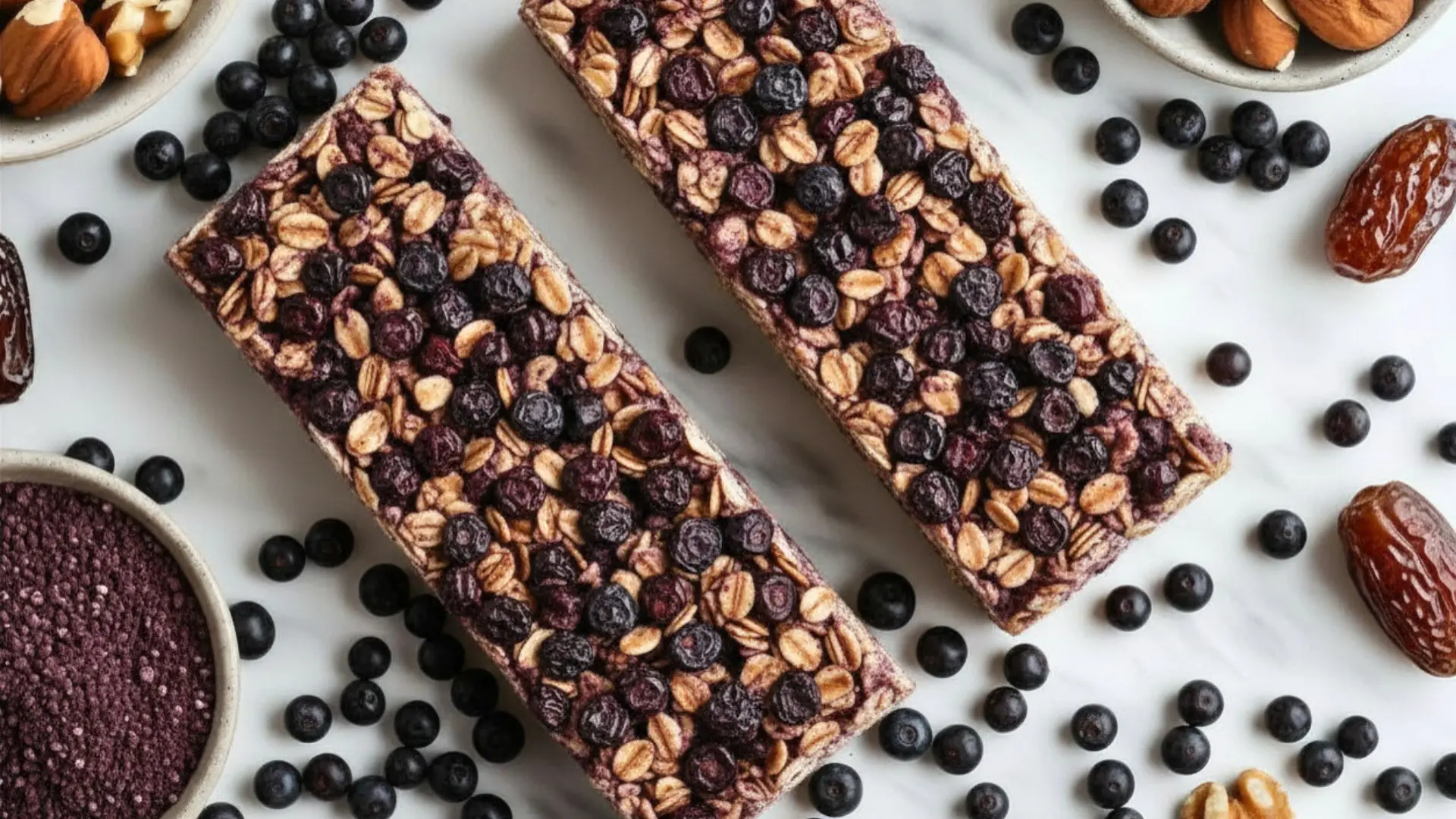
Energy bars, granola clusters, protein bites, and baked goods benefit from the powder's coarse, whole-fruit character. It provides natural color, anthocyanin content, and a recognizable fruit component that aligns with clean-label snack positioning — where ingredient lists are often the first thing a consumer reads on the wrapper.
Dairy and Plant-Based Products
Yogurts, plant-based bowls, frozen desserts, and functional dairy products gain a natural fruit input with color, flavor, and a Patagonian origin story. For plant-based brands especially, a 100% fruit ingredient with no additives fits the category's core promise of minimal processing.
Interest in Maqui Berry as a food-grade ingredient continues to grow globally — particularly in North America and across Asia, where formulators and consumers alike are actively exploring anthocyanin-rich, clean-label berry inputs for functional food products.
Looking for a whole-fruit Maqui ingredient?
Explore Freeze-Dried Maqui Berry Powder or request technical documentation and samples.
Frequently Asked Questions
As a whole-fruit powder, Freeze-Dried Maqui Berry Powder provides a natural source of anthocyanins — particularly delphinidins — along with dietary fiber, minerals, and vitamins in their original fruit matrix. Research on Maqui's anthocyanin compounds suggests they contribute to antioxidant defense at the cellular level. In food applications, the powder also delivers a distinctive deep violet color from its natural pigments, supporting clean-label positioning without synthetic colorants.
Freeze-Dried Maqui Berry Powder is the whole fruit — 100% Maqui Berry with its natural fiber, micronutrients, and pigments, with no added carriers. A concentrated extract like Maqui XT® is standardized to ≥ 25% anthocyanins and ≥ 20% delphinidins for higher, consistent potency and full water solubility. The powder suits clean-label whole-fruit food applications; the concentrate suits formulations that need a standardized anthocyanin level. Both originate from the same Patagonian Maqui Berry.
MNL Group's Freeze-Dried Maqui Berry Powder uses the whole fruit, including the seed, because the seed contributes to the powder's dietary fiber content and to the berry's complete nutritional matrix. This whole-fruit approach is an intentional product characteristic — it preserves what makes the Maqui Berry a complete fruit ingredient, not just an anthocyanin source.
In the context of this ingredient, clean label means the ingredient list is exactly one item: Maqui Berry. No carriers, no maltodextrin, no excipients, no solvents. The powder is 100% fruit, freeze-dried and milled — and the label reflects that directly.
It is partially water-soluble and works well blended into smoothies, shakes, and full-bodied drinks. For clear beverages, functional waters, or applications that need full solubility and a standardized anthocyanin dose, Maqui XT® — a water-soluble concentrate — is the better fit.
All Maqui used by MNL Group is wild-harvested in the forests of Patagonia, southern Chile, in collaboration with local communities under fair-trade and full-traceability standards. The berry grows naturally in the region's cold-climate forests, where the environmental conditions contribute to its rich anthocyanin profile.
- Fredes, C., Yousef, G.G., Robert, P., Grace, M.H., Lila, M.A., Gómez, M., Gebauer, M., & Montenegro, G. (2014). Anthocyanin profiling of wild Maqui berries (Aristotelia chilensis [Mol.] Stuntz) from different geographical regions in Chile. Journal of the Science of Food and Agriculture, 94(13), 2639–2648. doi:10.1002/jsfa.6602
- Romero-González, J., Shun Ah-Hen, K., Lemus-Mondaca, R., & Muñoz-Fariña, O. (2020). Total phenolics, anthocyanin profile and antioxidant activity of Maqui, Aristotelia chilensis (Mol.) Stuntz, berries extract in freeze-dried polysaccharides microcapsules. Food Chemistry, 313, 126115. doi:10.1016/j.foodchem.2019.126115
- Céspedes, C.L., El-Hafidi, M., Pavón, N., & Alarcón, J. (2008). Antioxidant and cardioprotective activities of phenolic extracts from fruits of Chilean blackberry Aristotelia chilensis. Food Chemistry, 107(2), 820–829. doi:10.1016/j.foodchem.2007.08.092
- Fuentes, L., Figueroa, C.R., Valdenegro, M., & Vinet, R. (2019). Patagonian berries: healthy potential and the path to becoming functional foods. Foods, 8(8), 289. doi:10.3390/foods8080289
- Gironés-Vilaplana, A., Mena, P., García-Viguera, C., & Moreno, D.A. (2012). A novel beverage rich in antioxidant phenolics: Maqui berry and lemon juice. LWT – Food Science and Technology, 47(2), 279–286. doi:10.1016/j.lwt.2012.01.020
- Arce-Johnson, P., Rodríguez-Alvarez, Y., Vallejos Sierra, C.G., et al. (2026). Clinical evidence on the health effects of Aristotelia chilensis (Maqui Berry) supplementation: a systematic review of human trials. Antioxidants, 15(6), 654. doi:10.3390/antiox15060654